
Find #13 · meteorite
A witnessed 1833 stone fall near Blansko, Moravia, was chemically analysed by Berzelius
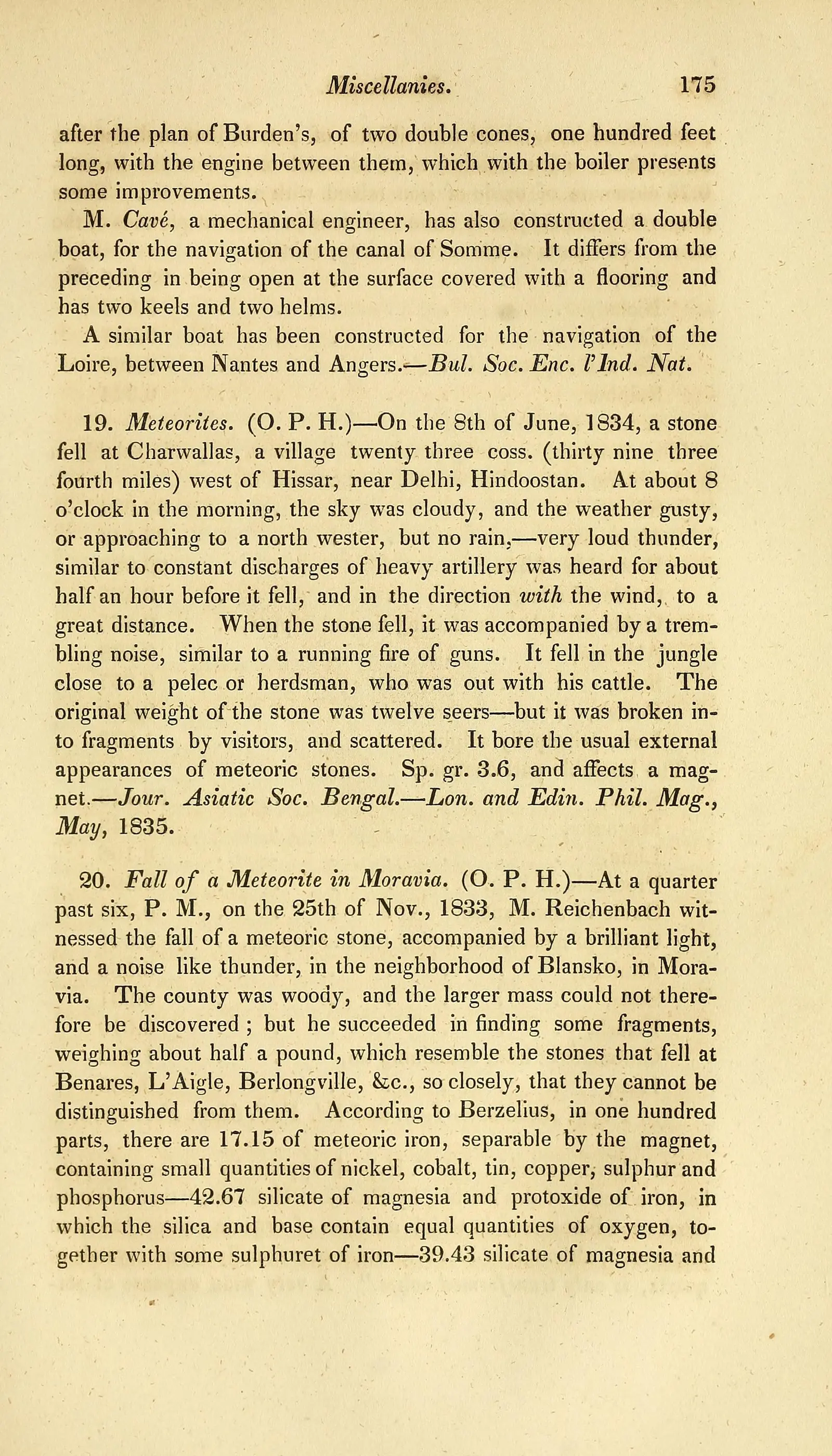
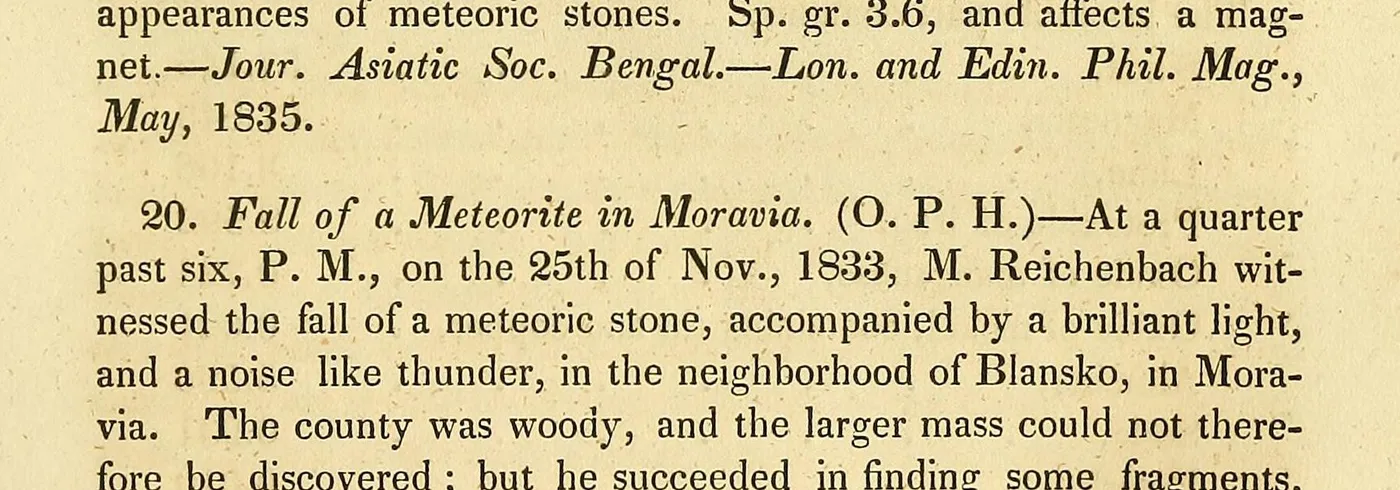
At a quarter past six, P. M., on the 25th of Nov., 1833, M. Reichenbach witnessed the fall of a meteoric stone, seeompinted by a brilliant light, and a noise like thunder, in the neighborhood of Blansko, in Mora- via.
Machine OCR of this passage At a quarter past six, P. M., on the 25th of Nov., 1833, M. Reichenbach wit- nessed the fall of a meteoric stone, seeompinted by a brilliant light, and a noise like thunder, in the neighborhood of Blansko, in Mora- via
Quote check Found on the page with OCR noise (100% match).
What the AI says
The journal reports that M. Reichenbach saw a meteoric stone fall near Blansko in Moravia at a quarter past six in the evening on 25 November 1833, with a bright light and a thunder-like noise. The main mass was lost in woodland, but about half a pound of fragments was recovered and compared to known falls such as L'Aigle. The page gives Berzelius's analysis, including about 17 percent magnetic nickel-iron; it is uncertain how the fall was later catalogued, since the Blansko meteorite is likely recorded in modern databases.
- How forgotten?
- little-known · A Blansko meteorite from 1833 appears in specialist meteorite catalogues, I believe, but it is not widely known to the general public.
- Web check
- Documented today · A Czech article describes the 25 Nov 1833 fall of stone meteorites (chondrites) northwest of Blansko. The Gallery of Natural Phenomena also lists the Blansko stone shower. I did not confirm the Berzelius analysis in the results. (10 sources seen)
- Wikipedia
- No matching article
- Significance
- 5 / 10
- Cost to find
- $0.07 (reading the page $0.0005, checking $0.07)
Source
The American journal of science and arts (v. 30 1836), 1820
View at Biodiversity Heritage Library · Internet ArchiveOpen the page viewer