
Find #12 · meteorite
A 12-seer stone fell during thunder near Hissar, India, in 1834
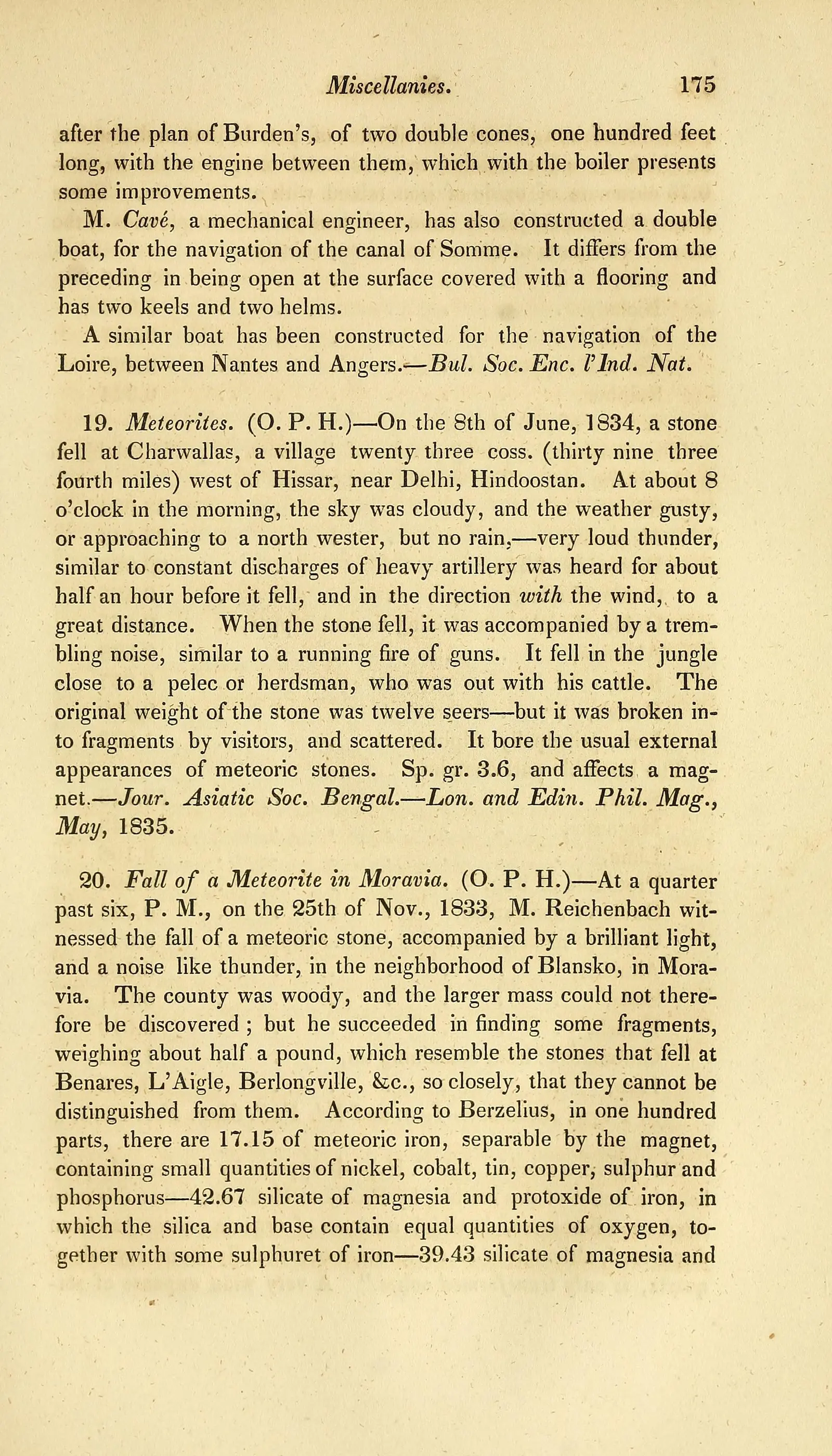
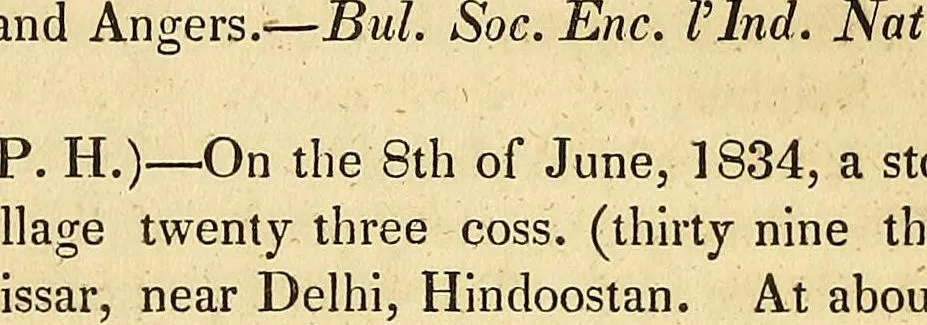
On the 8th of June, 1834, a stone fell at Charwallas, a village twenty three coss. (thirty nine three fourth miles) west of Hissar, near Delhi, Hindoostan.
Quote check Found word for word on the page.
What the AI says
The journal, citing the Journal of the Asiatic Society, reports that a stone fell on 8 June 1834 at Charwallas, west of Hissar, after about half an hour of loud thunder-like noise. It fell in the jungle near a herdsman and originally weighed twelve seers, but visitors broke it up and scattered the fragments. The notice gives a specific gravity of 3.6 and says the stone affects a magnet. It is unclear whether any fragments survive in collections today, or under what name.
- How forgotten?
- little-known · A fall near Hissar in 1834 may be listed in meteorite catalogues under a variant name such as Chandakapur or similar, but I cannot confirm this. The village spelling here is old and uncertain, so the fall could easily be overlooked.
- Web check
- Unclear · The search only turned up the historic archive index (meteoritehistory.info), which lists a Charwallas 1834 report. That is the same source family as the find. I found no independent modern catalogue entry, such as the Meteoritical Bulletin Database, for this specific fall. (10 sources seen)
- Wikipedia
- No matching article
- Significance
- 5 / 10
- Cost to find
- $0.07 (reading the page $0.0005, checking $0.07)
Source
The American journal of science and arts (v. 30 1836), 1820
View at Biodiversity Heritage Library · Internet ArchiveOpen the page viewer