
Find #10 · meteorite
A 700-gram stone from a Wisconsin fall was analysed by J. L. Smith in 1876
ALREADY KNOWNJ. L. Smith-New Wt'soollsin Mete01'ic Stone. 207
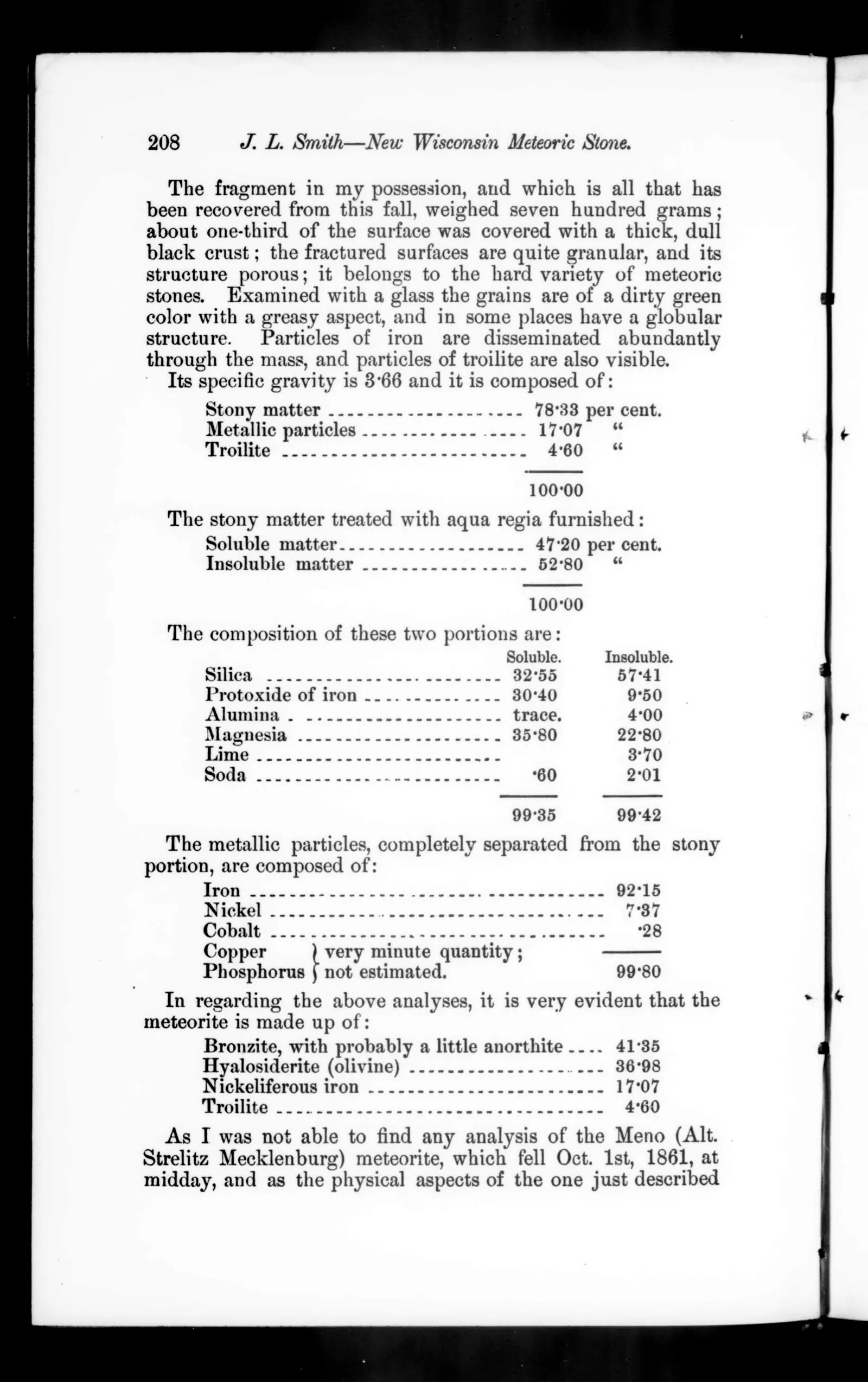
The fragment in my possession, aud which is all that has been recovered from this fall, weighed seven hundred grams; about one-third of the surface was covered with a thick, dull black crust;
Quote check Found word for word on the page.
What the AI says
J. L. Smith reports that a 700-gram fragment, said to be all that was recovered from the fall, was a hard, porous stone with a thick black crust and scattered iron and troilite. His analysis points to bronzite and olivine (hyalosiderite) as the main minerals. The page does not give the fall date or exact location, and the New Wisconsin stone may well be recorded in modern catalogues under a different name.
- How forgotten?
- little-known · Smith was a prominent meteorite chemist, so the stone is probably in specialist catalogues under a name such as Wisconsin or a local variant, but it is not widely known.
- Web check
- Documented today · The American Journal of Science article by J. L. Smith is online. It describes the 25 March 1865 Vernon County, Wisconsin fall, which he named Glaywater and found identical to the Menow meteorite. The 700 g fragment matches the quote. This is the original paper itself, not a modern secondary discussion. (10 sources seen)
- Wikipedia
- No matching article
- Significance
- 4 / 10
- Cost to find
- $0.07 (reading the page $0.0003, checking $0.07)
Source
The American Journal of Science and Arts 1876-09: Vol 12 Iss 69 (12), 1876-09